Introduction and Objectives
The invasive spread of the Asian hornet (Vespa velutina) poses a massive threat to native bee colonies and to biodiversity. Conventional bait traps, however, have a serious problem: they are non-selective. This often leads to considerable bycatch of protected species such as the European hornet (Vespa crabro), which undermines the ecological benefit of the traps.
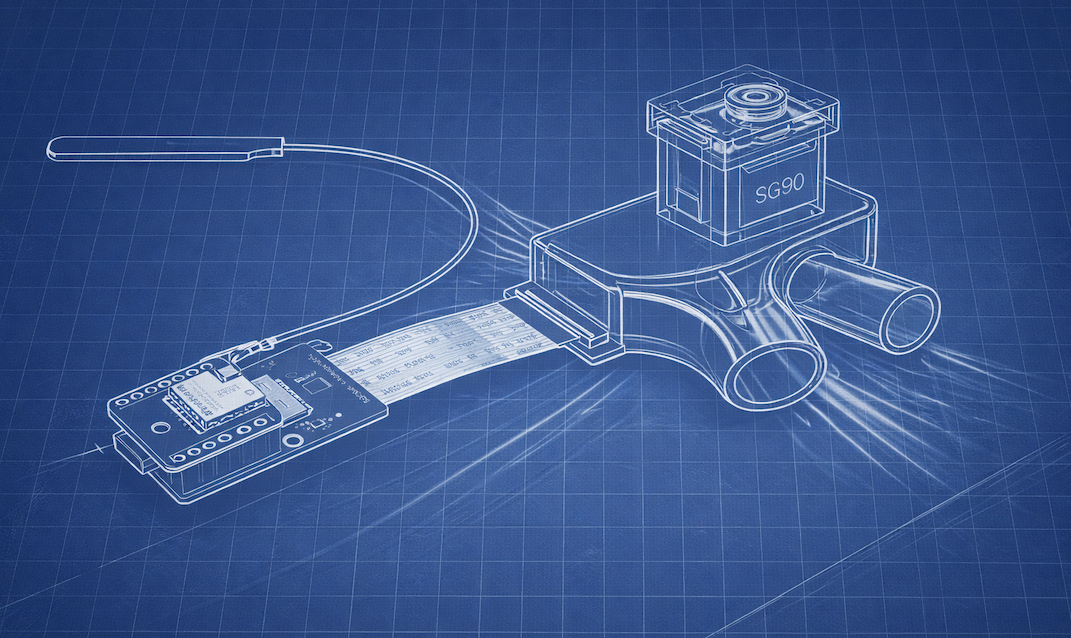
This project aims to develop an intelligent, selective trap that brings technology and species protection together. The guiding principles of the development are:
- Cost efficiency: Use of affordable off-the-shelf components (Himax WiseEye, ESP32, standard servos).
- Simplicity & reproducibility: The design can be built by makers and beekeepers without a specialized lab.
- Optimized for 3D printing: All mechanical components are designed for FDM printing at home.
- Energy efficiency: Optimized for months of self-sufficient battery or solar operation in the field.
1. System Architecture: Decentralized Inference (Edge AI)
To achieve the required energy efficiency, the system is based on a two-stage controller cascade:
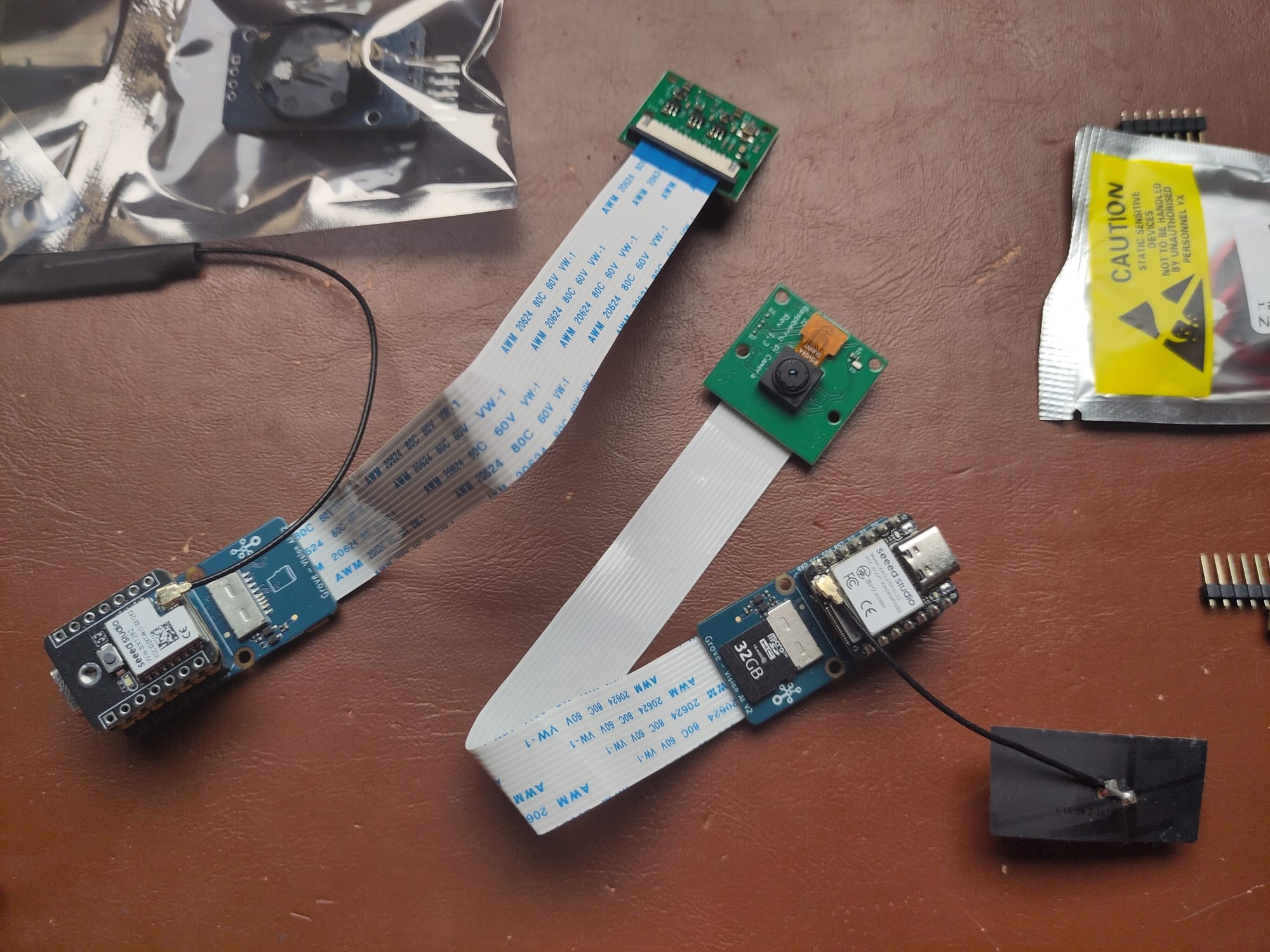
- Primary sensing (Himax WiseEye): A dedicated vision AI chip acts as a low-power image processing unit. The object detection models (CNN) were already trained and validated specifically for this chipset last year. They are currently already in use in the HornetLog App for species identification, which demonstrates that the algorithmic separation works in practice.
- System logic (ESP32): The main controller stays in deep sleep mode and is only woken up when the AI chip reports a positive detection. It controls the actuators and the communication module.
- Telemetry (LoRaWAN): Capture events and battery voltage are transmitted over the LoRa protocol via an SX1276 module, enabling long-range networking at minimal power consumption.
2. Mechanical Selection: The Spring-Loaded Y-Diverter with Fail-Safe (Variant 1)
The mechanical centerpiece is an active Y-diverter. This design was chosen because, compared to more complex systems, it is considerably easier to print and less sensitive to contamination (bait residue, insect remains).
Design Features of the Diverter
The diverter consists of a Y-shaped distributor housing with a centrally pivoted flap. A crucial safety feature is the integration of a torsion spring at the pivot point:
- Neutral position (default-safe): In the unpowered rest position, the spring presses the flap against a mechanical end stop. The path to the capture container is physically blocked; the escape route to the outside is open in a straight line. This guarantees that no animal is caught by accident in the event of a system fault or an empty battery.
- Activation (target match): Only on a verified detection of Vespa velutina does the servo work against the spring force and open the path into the capture container.
Documented Alternative Concepts
During the concept phase, the following mechanisms were also evaluated:
- Variant 2 (trapdoor principle): A horizontal slider opens the floor of the classification zone. (Increased risk of pinching).
- Variant 3 (linear piston selector): An axially sliding piston with internal channels switches between two outlets. (High demands on manufacturing tolerances and prone to sticking).
3. Safety Algorithms (Pinch Protection)
The protection of the insects during the switching operation is ensured by a multi-layered logic:
- Optical monitoring: IR light barriers in the area of the flap act as a hard lock. Switching is suppressed as long as the light path is interrupted.
- Software hysteresis: To avoid false triggers, the AI confidence must remain stable above 85% over a defined time window.
- Stall detection (optional): Monitoring the actuator’s current draw detects mechanical resistance immediately and initiates a return to the neutral position to protect animal welfare.
4. Hardware Foundations and Further Development
The concept presented here used functional principles of existing open-source solutions (such as the funnel principle of the Adamow design from 2023) as its technical starting point.
However, it is expressly stated that the design documented here is an independent development of the housing and mechanics. The current prototype integrates the electronics and the specific diverter mechanism into a compact, functional unit.
Conclusion and Outlook
This project is currently in the active prototype phase. The combination of locally running vision AI, the spring-loaded fail-safe mechanism and the integrated safety algorithms offers a promising path towards intelligent species protection.
With this documentation I want to share my results so far and the mechanical approaches I evaluated with the community. My goal is to create an open knowledge base that can serve as a foundation for further development and ensures that this technology remains freely accessible to everyone.