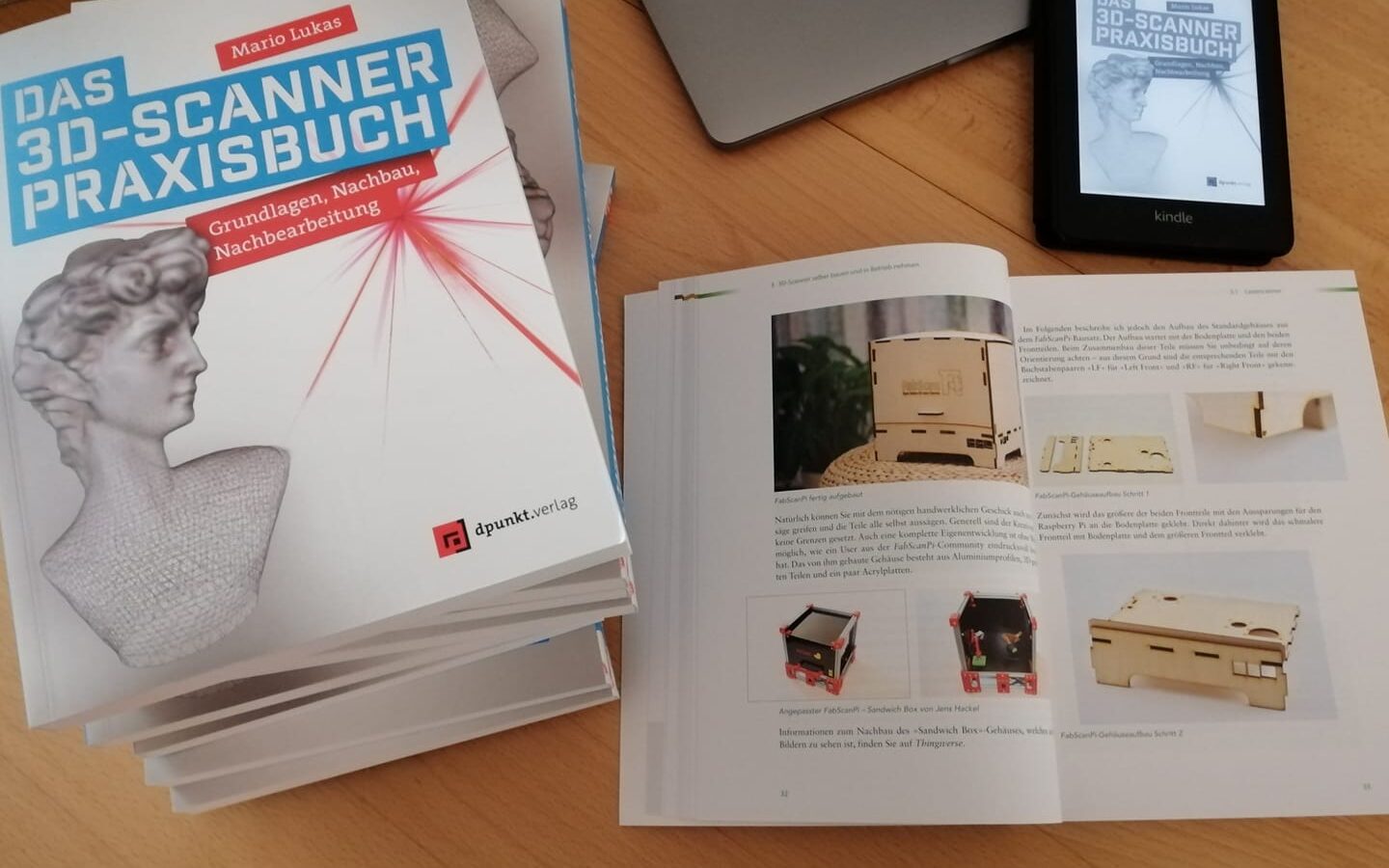
The time has finally come. My latest work, “Das 3D-Scanner Praxisbuch”, is finally finished. This book very nearly didn’t happen at all because of a major data loss.
Disaster just before the finish line
Since the manuscript was written entirely in Markdown, I wanted to get a better overview by using a different format. So I tried to have a bash script instruct a text processor to convert the Markdown into another format. Unfortunately, the clean routine of my script had a bug in a regular expression, which resulted in all files being deleted except for the generated PDF files.
It took a lot of effort and patience to restore larger parts of the text in the original format. Most of the pictures, however, I had to redo.
Of course I could now claim that I’ve learned my lesson and will dutifully back up my important data from now on. In practice, things usually turn out differently. And yet, with my MacBook I have the best option for this in Time Machine. Most of the time I don’t need backups, since my source code in particular often lives on GitHub, where I always have a current version of my work. With the book project that was of course not the case.
So what’s in it?
All the more reason for me to be happy that the effort paid off and that in the end I get to hold a finished book in my hands.
The book is aimed at beginners in 3D scanning as well as at somewhat more advanced readers. For 3D scanning professionals, this book certainly doesn’t offer any real added value.
My book mainly describes 3D scanning methods that are of particular interest to home users and makers. The techniques covered include 3D laser scanners, photogrammetry and depth sensors, among others.
The first chapter is mostly about the theory behind the individual techniques. I deliberately refrained from descending into the depths of mathematics. There is plenty of material and information on the internet for digging deeper into the subject. The chapter is merely meant to provide an overview.
From a bit of theory to practice
Each of the following chapters presents a build-it-yourself variant of one of the techniques described. These come with lots of practical tips for getting better scan results.
Another chapter describes how to process and clean up raw 3D scan data, i.e. the point clouds, and turn it into a surface model.
Finally, there is a chapter that uses practical examples from everyday life and hobbies to show where and how 3D scanning can be put to use.
Conclusion
So the book is suitable for anyone who wants to get started with 3D scanning but isn’t yet sure where to begin. And of course it’s also suitable for anyone who wants to support my work on the FabScan.
So if you now feel the calling, you can find it behind the following link: https://amzn.to/2ZiXsSm
Comments